

The Odyssey:“We men are wretched things”

Updated: Aug 22

“Men are so quick to blame the gods: they say
that we devise their misery. But they
themselves- in their depravity- design
grief greater than the griefs that fate assigns.”
― Homer, The Odyssey
The Odyssey is the archetype (from Greek archetypos, “original pattern”) of epic journeys. It defines the word “odyssey” in current language usage to mark a monumental challenge against unwavering odds and obstacles.
The Odyssey translates from the original Greek Odýsseia as The Song Of Odysseus, which, in turn, relates to the oral tradition of travelling storytellers who would share stories through speech, song, poetry, and performance, probably with embellishments as the story evolved from generation to generation. The Odyssey, originally, was shared in this manner.
“A rhapsode was an ancient Greek professional reciter of poetry, particularly the works of Homer. They played a key role in the transmission of oral tradition. The word 'rhapsode' comes from the Greek words 'rhaptein' meaning 'to sew' and 'ode' meaning 'song'. A rhapsode, therefore, was someone who 'stitched together' stories.”
From Storytellers known as rhapsodes, OxfordReference.com

Homer recorded the quest of Odysseus in written form. In a contemporary setting, filmmaker Christopher Nolan has interpreted the epic quest, based on Emily Wilson’s translation of Homer, using moving images and sound to entertain and captivate modern audiences.
Nolan is a modern storyteller who uses technology—camera lenses, sound recording, scripts, acting, editing, costumes, set design, special effects—and cinema distribution to promote and share the tradition of epic storytelling. As with all storytellers, he interprets, embellishes and shapes his creative fictions. Even Homer admitted to elaborating the details of his stories.
“I didn't lie! I just created fiction with my mouth!” Homer
Muse, tell me how (Odysseus) wandered and was lost/ when he had wrecked the holy town of Troy,/ and where he went, and who he met, the pain/ he suffered in the storms at sea, and how/ he worked to save his life and bring his men/ back home.
— The Odyssey, Book I, Homer; translation, Emily Wilson
And thus begins the story of Odysseus, an odyssey that chronicles the 10-year homeward journey of Odysseus, King of Ithaca, following the fall of Troy at the conclusion of The Trojan War. While Odysseus endures the rage of ancient gods due to his own hubris—as well as giants, such as the Cyclops Polyphemus; the temptation of The Sirens and their divine songs that drive men insane, literally; the nymph Calypso (Charlize Theron), who feeds Odysseus lotus flower leaves to make him forget his home and family; Circe (Samantha Morton), who transforms men into beasts, and shipwrecks—his loyal wife Penelope and son Telemachus must contend with a palace overrun by aggressive suitors seeking to steal his throne.
Calypso; Odysseus & mythical Greek god Athena
Ultimately, Odysseus confronts the realisation that his actions have resulted in the deaths and misfortunes of his own men and the brutal slaughter of women, men and children during the siege of Troy.
Nolan has undertaken a monumental task. He follows Homer’s path while simultaneously exploiting the film techniques at his disposal to stitch together his own song of Odysseus.
The question became one of how to approach the movie. I came with prior knowledge of The Odyssey, the seminal nature of the quest, and a level of expectation and excitement. Other viewers, of course, would have little or no knowledge of the lore surrounding The Odyssey.
I approached the movie with familiarity about Odysseus’s travails while assessing Nolan’s movie as a self contained entity.
Nolan deserves credit for tackling a formidable task.
Nolan sets the scene early to explain Odysseus’ desire and yearning to return home to his wife Penelope despite Calypso’s entreaties for him to stay with her. The thread throughout the movie with Calypso and Odysseus binds the movie’s central premise, a longing to return to family and his home.
I approached Nolan’s Hollywood quest with trepidation about the casting of Matt Damon as Odysseus and Anne Hathaway as Penelope. Damon’s ability in embodying the qualities of Odysseus convinced me that he was the flawed heroic figure. Anne Hathaway, on the other hand, came across through her mannerisms and dialogue as a modern American suburban housewife and mother. Hathaway’s Penelope , like Odysseus, does convey a sense of her wily and shrewd nature in delaying the entreaties of her suitors to choose one of them as her husband in the belief that Odysseus would never return to Ithaca.
Top row: Odysseus, Telemachus
Bottom row: Penelope, Antinous
Her son, Telemachus (Tom Holland), also presented himself as a contemporary twenty year old, while Robert Pattinson as Antinous, the conniving, villainous and cowardly suitor, convinces us of his dastardly nature but performs in what could be deemed a modernistic depiction.
Elements of dialogue were too modern and unsuited to an ancient Greek story. Baz Luhrmann’s movie, William Shakespeare's Romeo + Juliet, is a superb interpretation of a classic text refreshed through modern staging as an LA gangland story.
Many more characters and key figures, their names and relationships with one another could be confusing to someone without awareness of The Odyssey, hence the undue time taken in the movie to explain emotions, feelings, and historical links.
The creature encounters are formidable but don’t offer the nuances that these encounters revealed about Odysseus’s hubris, cunning, leadership, as well as the weaknesses of his character, in Homer’s text. This is a case of prior knowledge overshadowing my assessment of Nolan’s movie. Other people with whom I discussed the movie either weren’t affected by the lack of nuance because they were not aware of the text or felt the interaction between characters was strong enough to carry the movie regardless of the encounters with monsters and mythical beings.
The Cyclops Polyphemus; the Laestrygonians
Many of the sequences, even the action-packed adventures battling giants and monsters, appeared flat and lacked tension. Many scenes were paced evenly, regardless if they had different physical and emotional weight. The scenes featuring the attack by the giant cannabalistic warriors, the Laestrygonians, seems a distraction to sate the audience’s lust for monstrous creatures. It’s an escapade rather than an integral part of the whole journey. The sequence could be cut without affecting the flow and tenor of the movie’s epic nature.

The Destruction of Troy
The threads of the Trojan War are woven effectively into the movie. The diabolical and furious nature of the sacking and destruction of Troy, which is detailed in Homer’s The Iliad, the precursor to The Odyssey, unleashes fury in a definitive sign of Odysseus’s emotional turmoil and inner psychological fury. His actions represent his true nature and his ultimate recognition that he needs to make amends for his failings.
Although the end drips of sentimentality at times, it also marks a magnificent moment that reveals how one sound—the sound made when Odysseus strings and plucks his archery bow—signals to all the suitors and the court of the king that Odysseus has returned and he is there to claim his position as king of Ithaca.

Nolan’s creative decision regarding the song of The Sirens is equally inspiring. He handles the dilemma of how to create an ethereal, other-worldly song appropriately and effectively.
The Odyssey was an enormous mountain to climb. Nolan has climbed, slipped, traversed the face cliff sideways and reached the summit of a massive achievement that is part Hollywood, part mythology, part Homer, but all Nolan.
It is not perfect but can any filmmaker claim perfection? Nolan can only offer his cinematic “song” of The Odyssey, in the tradition of Homer, translated by Watson and now interpreted by Nolan.
Like the troubled hero Odysseus, Nolan’s movie is flawed.
Would I rush to see it? Probably not. Is it worth seeing to place it in the anthology of quest movies? The answer is yes. Most importantly, like the ancient storytellers, Nolan has connected with his audience—the modern day cinema audience—to provide a cinematic spectacle.
Offiicial Trailer: Christopher Nolan's The Odyssey
All photo stills and video trailer © 2026 Universal Pictures & Syncopy, Inc.
FILM EXTRAS: The Quest
J.R.R. Tolkien’s The Hobbit or There and Back Again
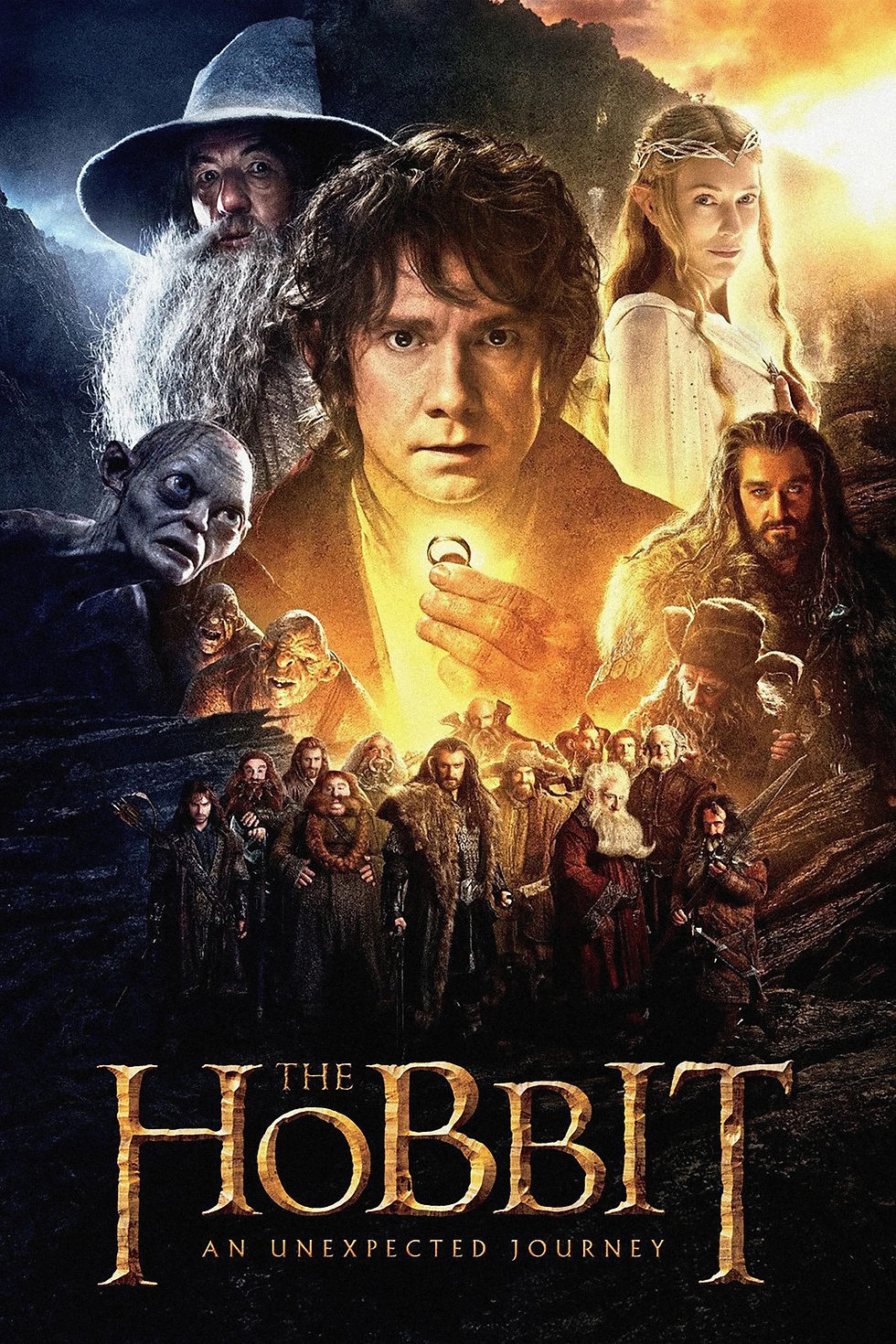
Book: J.R.R. Tolkien’s The Hobbit or There and Back Again
Movies: Peter Jackson’s The Hobbit movie trilogy An Unexpected Journey (2012), The Desolation of Smaug (2013), & The Battle of the Five Armies (2014)
J.R.R. Tolkien's The Hobbit, set in Middle Earth, follows Bilbo Baggins, a home-loving hobbit who joins the wizard Gandalf and thirteen dwarves on a quest to reclaim the dwarves’ stolen treasure from the dragon Smaug. Along the way, Bilbo finds a magic ring—the One Ring
faces dangerous creatures, and develops into an unassuming, reluctant hero.
J.R.R. Tolkien’s The Lord of the Rings

Book: J.R.R. Tolkien’s The Lord of the Rings
Movies: Peter Jackson’s movie trilogyThe Fellowship of the Ring (2001), The Two Towers (2002), & The Return of the King (2003)
J.R.R. Tolkien’s The Lord of the Rings chronicle Bilbo Baggins’ epic quest to take the evil One Ring to Mount Doom in the dark land of Mordor to destroy it and defeat the Dark Lord Sauron before he enslaves the world.
Jason and the Argonauts (1963)

Jason and the Argonauts is a Greek myth about the heroic Jason who sails with a team of brave men on a ship called the Argo to find the magical Golden Fleece. He must get the fleece to win back his stolen kingdom. During their legendary quest for the Golden Fleece, Jason and his crew face terrifying mythical monsters, including Talos the bronze giant, the winged Harpies, the Skeleton Army and the fierce Colchian Dragon, all created in stunning landmark sequences by the brilliant stop-motion animator Ray Harryhausen.
Clash of the Titans (1981)

The original Clash of the Titans, a 1981 epic fantasy adventure film directed by Desmond Davis, is based on the Greek myth of Perseus, featuring legendary stop-motion visual effects by Ray Harryhausen and an all-star cast including Laurence Olivier, Maggie Smith and Claire Bloom.
The Princess Bride (1987

Book: William Goldman’s The Princess Bride
Movie: Rob Reiner’s The Princess Bride
The Princess Bride is a wonderful fantasy adventure that follows a young farmhand named Westley on a quest to rescue his true love, Buttercup, from being forced to marry the villainous Prince Humperdinck. Written as a "story within a story," the main narrative is framed by a grandfather reading a book to his sick grandson. Fabulously written tale with memorable characters and dialogue.


